Karl Oskar and Kristina’s marriage
The EmigrantsKarl Oskar and Kristina’s marriage joins an enduring personal attachment to the material pressures of farm life: they build a household together at Korpamoen, endure mounting debt and crop failure, and ultimately face the question of what future their children can inherit. Their relationship is neither untouched by hardship nor reduced to it. The novel follows their affection through long workdays, anxious silences, and the common resolve that makes emigration thinkable.
Meeting and courtship
Karl Oskar first meets Kristina in Idemo, where she is staying with Berta to recover from a knee injury. He has brought firewood to Berta’s home; Kristina is quietly spooling yarn. Before leaving, he introduces himself, and she gives her name. That restrained exchange marks the beginning of a relationship whose importance neither can yet know.
Karl Oskar finds further reasons to visit Berta, and he and Kristina meet while she remains in Idemo. When her knee heals, she no longer limps or feels ashamed to walk where he can see her. On the evening before she is due to return home, they sit together on an upturned potato basket outside Berta’s cellar. He tells her that he likes her and asks whether she feels the same. She does, but when he proposes marriage she answers that they are both too young and that he should at least reach adulthood first. His suggestion that he could ask the King for permission does not resolve her practical concern: they have nowhere to live and no clear way to feed or clothe themselves. Karl Oskar has no answer. He treats a spoken promise as a serious obligation, not words that can later be withdrawn.
They continue to meet at the Klintakrogen fair, and each time Karl Oskar tells her that he still likes her and thinks of no one else. When his father offers him Korpamoen, he goes to Kristina’s parents in Duvemåla and asks to speak with her. Her parents accept him into the family once they learn that his intentions are earnest and that he owns a farm. He stays overnight, and he and Kristina sleep fully dressed, with propriety observed. Six weeks later they marry in Duvemåla. He tells his young wife that no one in the world pleases him as much as she does, because she does not criticize him as others do, and that he expects to be happy with her throughout his life.
Building a household at Korpamoen
Their marriage begins alongside a difficult transfer of property. In 1844 Karl Oskar takes possession of one-sixteenth of a homestead, Korpamoen, for a price of 1,700 riksdaler, including an 800-riksdaler mortgage. His parents, Nils and Märta, retain rights to live in the spare room, receive fodder for a cow and a sheep, use three-quarters of an acre and the farm team, and take twelve bushels of grain each year. Those provisions secure the parents’ maintenance, but also bind the young couple to a long-term obligation. Karl Oskar’s savings from seven years of service, Kristina’s 200-riksdaler dowry, and his inheritance of 210 riksdaler cover only a quarter of the purchase price. He must pay 50 riksdaler in annual mortgage interest, while the reserved rights remain a further debt on the farm for as long as his parents live. He accepts the burden because he believes work can reduce debt.
Kristina arrives with her dowry chest and takes over the domestic place Märta has occupied. The first evening, she spreads the blue bridal cover she has sewn over the marriage bed; Märta has praised it, and Kristina is proud of her work. The cover will later accompany the couple into the rye field, changing from a wedding keepsake into a means of saving grain. Its recurring presence connects the beginning of their married life with the work that sustains their household.
The family grows while the farm remains small. In 1847 Kristina gives birth to twins: the boy is sickly, receives emergency baptism, and dies within a fortnight; the girl survives and is named Märta after Karl Oskar’s mother, later becoming known as Lill-Märta. After four years of marriage Kristina has had four children, while three are alive and sleeping near the couple. When she thinks back on how they met, she traces their family life to her fall from a swing at her parents’ home: the injury led her to seek treatment in Idemo, where she met Karl Oskar. In her understanding, the accident, their marriage, the farm, and their children form a chain of events directed by God. Even after becoming a wife and mother, she secretly makes another swing in the threshing barn, though she knows her mother-in-law thinks such play unfitting.
Hardship, care, and communication
The farm’s economy steadily strains the marriage. In 1847 Karl Oskar has to borrow the full mortgage interest, and Nils can no longer lend him money. Kristina suggests asking her uncle, Danjel Andreasson, who promptly lends him 50 riksdaler for the interest. Yet after three years at Korpamoen, the couple have one fewer cow and 70 riksdaler more debt than when they took over. Both have worked to the utmost, but weather and animal luck have defeated the expectation that health and effort alone will bring them ahead. Nils cites the teaching that people earn bread by the sweat of their brows; Karl Oskar replies that work and sweat do not even guarantee bread.
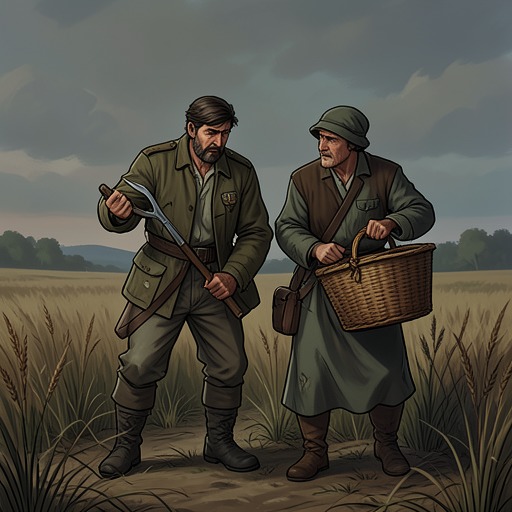
The drought makes daily labor visible in the smallest returns. When the rye is cut, Karl Oskar and Kristina spread the quilted bridal cover on the stubble so that fallen kernels will be caught instead of lost. Kristina also gathers broken heads in her apron. By evening the cover holds only a tenth of a bushel of grain, enough for a few loaves, while the field has yielded just one-third of its usual crop. The cover that once marked the start of their marriage now helps them salvage food from a failing harvest. At the same time, Kristina notices that Karl Oskar has grown silent. Their talk has narrowed to the day’s work, tomorrow’s tasks, and the repeated question of whether rain will come. The wider community shares the strain: people are sullen and short-tempered, and even children are discouraged from laughing because of the coming winter.
The couple’s silences can be mistaken for a change in affection. Kristina eventually asks Karl Oskar directly what is on his mind. He says he is worried about how the family will live and where their food will come from. She is in her fifth month of pregnancy, and there will soon be eight people at Korpamoen, though the farm will never exceed seven acres. His distress leaves her in tears. When she has quieted, he explains that he has withdrawn because of his worries, not because he disapproves of her or resents another child. He tells her that his wife and children are his dearest possessions, and that he will love the new baby as he loves the others. His assurance reconnects economic fear to the attachment underneath it: his silence is not indifference, but anxiety over the people he loves.
Shared decision and the meaning of departure
After four years, Karl Oskar sees continued effort at Korpamoen as leading only to exhaustion. The couple are several hundred riksdaler poorer than when they began, and he imagines their future as a gradual wearing-down until they are left with only the reserved room and meager provisions guaranteed to his parents. He contrasts that prospect with the fertile, stone-free land he believes can be obtained cheaply in the United States. He does not claim that work there will be easy; rather, he believes that hard work might finally improve their circumstances. In his view, the decisive difference is the possibility of working toward a goal instead of laboring without progress.
The future of their children sharpens the choice. One child may inherit the farm, but Karl Oskar sees no comparable prospect for the others: they would have to become hired farmhands or squatters. The parish’s divided farms and growing population give this concern a wider context. Holdings once made up of 43 homesteads have multiplied through inheritance division into 254 farms, two-thirds of them one-eighth of a homestead or smaller; on the first day of 1846 the parish had 1,925 inhabitants, while the number of people without assessed land or permanent homes had risen sharply over the preceding century. Karl Oskar and Kristina do not want their children confined to hired service or a precarious cottage life, and he argues that responsibility for them requires leaving.
Their resolve is not shared by everyone. Karl Oskar knows that people mock his plan, and that his parents disapprove, partly because their reserved rights will have to be met by someone else. Nils quietly tells him that he is taking many people along. Karl Oskar answers that there will be six of them; Nils points beyond the immediate household to descendants his son cannot yet count. The exchange gives the decision a generational scale: emigration is not simply a bid to escape present debt, but a choice with consequences for the family line.
As the departure becomes practical, the old family clothes chest is brought down from the attic and prepared as the roomiest, strongest packing case available. It has passed through generations and been used at baptisms, weddings, and funerals; now, five feet long and three feet high and reinforced with broad iron bands, it is to travel across the sea. The packing makes the marriage’s shared history tangible. Karl Oskar places his tools and hunting equipment in the chest, while Kristina chooses wool cards, needles, shears, clothing, yarn, and mending supplies. She must leave behind familiar implements of household work because they take up too much space, though she knows she will miss them. The marriage that began with a cautious exchange of names and became a household built through labor now faces departure together, carrying both practical means of survival and objects bound to memory.